
How to Read Bass Spawning Flats (And Actually Find the Beds)
Share this article with every angler you know!
How to Read Bass Spawning Flats
You pulled up to the flat. It looks right. Shallow water, protected cove, the right time of year. You have been working it for 45 minutes with a white swim jig and a quiet confidence that has slowly curdled into quiet desperation.
Nothing.
The bass are in there somewhere. They have to be. But finding a spawning flat and finding the fish on it are two very different skills, and most anglers stop at the first one.
Reading a spawning flat means understanding why bass choose the specific pieces of it they choose: the bottom composition under the water, the depth relative to nearby structure, the access to escape routes, and the way those variables combine differently depending on whether you are fishing a Tennessee reservoir, a Minnesota natural lake, or a California delta. Once you know what to look for, a flat stops being a featureless expanse of shallow water and starts telling you exactly where to cast.
Sign up to be notified of new bass fishing articles!
Get the Bass Fishing Playbook Every Week
Why Bass Choose the Flats They Choose
Bass do not spawn on flats randomly. The location of every bed on every lake reflects a set of preferences that are consistent enough to predict once you understand the logic behind them.
Why Shallow and Warm
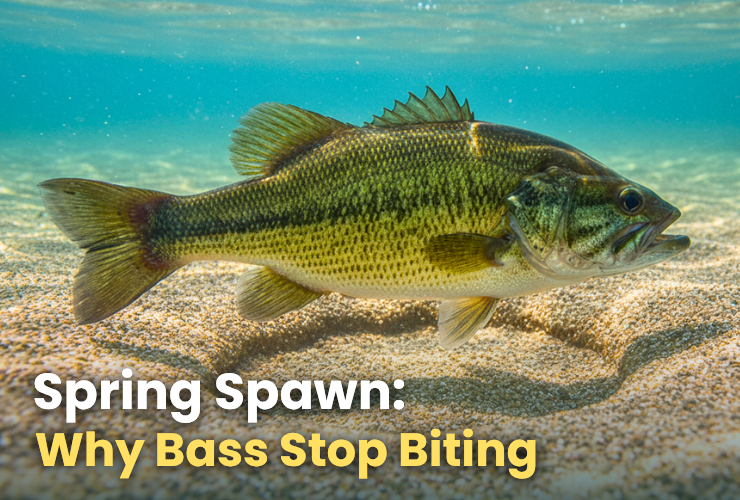
Shallow water warms faster than deep water. Bass eggs require relatively warm and stable water temperatures to develop properly, and a flat in two to four feet of water can climb several degrees above the temperature of adjacent deeper areas on a sunny afternoon. That thermal advantage is one of the primary reasons bass move shallow to spawn rather than reproducing at depth.
Shallow water also gives the male bass guarding the nest a clear sightline in all directions. A fish defending a bed at four feet can see a threat approaching from almost any angle. At fifteen feet in stained water, that visibility disappears.
Why Hard Bottom
This is the most important variable on any spawning flat, and the one most anglers understand least. Bass strongly prefer gravel, rock, shell, and hard clay as spawning substrate. The reason is functional: eggs adhere to a firm surface rather than sinking into soft sediment, and water moving through gravel or around rock keeps the eggs oxygenated during the incubation period.
Eggs deposited on a soft mud bottom are more vulnerable to silting over, suffocation, and disruption. Bass will spawn on mud when better options are not available within reasonable staging distance, but given a choice between a gravel point and a mud pocket in the same cove, the gravel will hold fish first, hold more fish, and hold them longer.
Why Proximity to Deeper Water
A spawning flat that drops immediately into deeper water on one side is almost always more productive than a flat surrounded entirely by shallow water. That depth access serves two purposes.
First, it is a staging corridor. Female bass and pre-spawn fish approach the flat from adjacent deeper water and move up incrementally as conditions warm. The fish do not materialize on the flat from nowhere. They travel a path from their winter holding areas through staging zones to spawning locations, and flats with direct depth access sit at the end of that path.
Second, it is an escape route. Bass on beds in two feet of water are exposed. When a front approaches, a boat passes too close, or a predator enters the area, the fish need somewhere to go quickly. A flat with a nearby drop gives them that option. A flat surrounded by eighteen inches of water in every direction does not.
Bottom Composition: What You Are Looking For and Why
If you only learn one thing from this article, learn to read bottom composition. It will find you more beds than any other single skill.
Gravel and Chunk Rock
Gravel and chunk rock are the gold standard for spawning habitat. If a flat has a section of visible rock or gravel bottom and the rest is featureless sand or mud, start there. The fish know where it is. They have known where it is for years.
On a graph, hard rocky bottom returns a brighter, crisper signal than soft bottom. The bottom line appears thicker and more defined. With a little practice you can read the transition from hard to soft bottom while idling across a flat before you ever make a cast, which saves you from spending an hour fishing the wrong end of it.
Shell Beds
Shell beds are underrated and under-fished on almost every lake that has them. They are common in Southern reservoirs and natural lakes with mussel populations, and they produce the same functional benefit as gravel: a hard, irregular surface that eggs can adhere to with water circulation through the gaps.
Shell beds are often invisible from the surface. A drag of a Texas-rigged worm across the bottom will tell you immediately if shell is present. The distinctive clicking sensation through the rod tip is unmistakable once you have felt it once. When you feel it, slow down and stay there.
Sand and Clay
Sand is a middle-tier spawning substrate. It is firm enough to support a nest and does not silt over eggs the way mud does, but it lacks the irregular surface of gravel or shell that makes a bed structurally stable. Bass will spawn on sand when gravel or shell is not available in the area, and a protected sand flat can hold a significant number of fish during peak spawn.
Hard clay is similar. It is firmer than sand and more stable, and it is common on the points and pockets of older reservoirs where the original lake bottom was clay soil. A clay point on a flat is worth fishing. It will not hold as many fish as gravel, but it will hold more than the mud section twenty feet away.
Mud
Mud is where bass go to disappoint you. It is soft, it sieves over eggs, it offers no structural anchor for a nest, and bass avoid it when anything better is within reasonable distance. You will occasionally find a bed on a mud flat when a fish had no other options and committed anyway, but if your flat is primarily soft mud bottom, adjust your expectations before you start fishing it.
That said, do not write off a mud flat entirely if it has any harder features within it. A submerged stump, a patch of shell, a single rock the size of a basketball: any hard object on an otherwise soft flat becomes a bed magnet. Find the hard spots on the mud flat and you will find the fish.
Reading Bottom Composition Without Seeing It
Not everyone is fishing from a boat with a graph. Not every lake has clear enough water to read the bottom visually. Here is how to gather the same information through feel and observation.
A Texas-rigged worm or jig dragged slowly across the bottom is the most reliable bottom composition reader available. Gravel and shell transmit a distinct tick or click through the rod. Hard clay returns a smooth, firm drag. Sand feels gritty and slightly resistant. Mud feels like dragging a bait through cold butter.
Water color is also a clue. A flat where runoff has stirred up fine particles often has softer bottom. A flat with clearer water relative to the surrounding lake may have harder substrate underneath. Not a guarantee, but a starting point when you are fishing blind.
Depth: Why "Two to Six Feet" Is the Beginning of the Answer
Every article on bass spawning tells you the same thing: two to six feet. It is not wrong. It is just incomplete.
The actual spawning depth on any given body of water is primarily determined by water clarity. In clear-water lakes, bass push deeper to find the light levels they prefer and to avoid the visibility that shallow, clear water creates for predators. Beds in clear highland reservoirs and northern natural lakes can be found in eight to twelve feet of water without being unusual. In stained Southern reservoirs where visibility runs two to three feet, beds may be in eighteen inches.
Fishing pressure adjusts this further. On heavily pressured lakes in clear water, fish learn to associate boat presence and anglers with danger. Over time, the most accessible shallow beds get disrupted repeatedly and the fish shift deeper. On a remote natural lake with minimal boat traffic, you may find fish shallower than you expect.
Cover availability is the third variable. Bass prefer a specific depth range, but if that depth has no hard bottom or structural features, the fish will adjust. A gravel shelf at eight feet in clear water will hold more fish than a featureless hard-bottom flat at four feet on the same lake.
Use "two to six feet" as the starting range and then let the lake's clarity, pressure history, and structure tell you where within that range — or outside it — the fish have set up.
Flat Types: Reservoirs, Natural Lakes, and River Systems
The characteristics of a productive spawning flat in a Tennessee reservoir are different from those in a Minnesota natural lake, which are different from those in a California delta system. Knowing which type of water you are fishing changes where you start looking.
Reservoirs
Reservoirs are created by damming river systems, which means their structure reflects the original river valley, creek drainages, and surrounding topography. That geology produces consistent patterns for finding spawning habitat.
Creek arms and secondary pockets are the first places to look. Bass in reservoirs follow creek channels from their winter depth and move into the arms as the water warms. The back halves of creek arms, where the channel shallows out and the bottom transitions from soft silt to harder clay or gravel near the original creek bed, are historically productive spawning areas on almost every reservoir in the country.
Secondary points, the smaller points inside coves rather than the main lake points, often have the depth access and hard bottom that spawning fish prefer. The inside turns of a creek arm, where the channel bends close to the bank, create natural staging and spawning areas.
Avoid the backs of large, wide, shallow coves with no depth access. They look like ideal spawning habitat but often lack the creek channel access and hard bottom that consistent bedding areas require.
Natural Lakes
Natural lakes have a different structure entirely. They were not formed by river systems, so there are no creek arms or drainage channels to follow. Instead, the productive spawning features are weed flat edges, protected sand or gravel points, and wind-sheltered bays.
In natural lakes with abundant vegetation, the inside edge of the weed line in two to six feet of water is the primary spawning location. Bass nest just inside or along the outside edge of emergent and submergent vegetation where the weeds provide cover and the open bottom between clumps provides hard spawning surface.
Sand points and hard-bottom bays that face away from the prevailing wind get the most solar exposure and warm fastest in spring. In northern natural lakes, south-facing protected bays can be five to eight degrees warmer than exposed shorelines on a calm afternoon, and that temperature difference dictates where the spawn starts.
River Systems and Backwaters
River-connected lakes, delta systems, and backwater sloughs have their own set of variables. Current is the primary consideration. Bass in flowing water systems move out of the main current to spawn in backwater areas, oxbow pockets, sloughs, and protected cuts where water is still enough to allow nest construction and incubation.
Flooded terrestrial cover in river systems — newly inundated bushes, standing timber, root wads at the base of shoreline trees — creates the structural anchors that bass use as spawning sites when traditional hard bottom is limited. The beds may be associated with a specific stump, root system, or clump of flooded brush rather than a section of bottom composition.
Current edges where the flow splits around a point or island create calm pockets on the downstream side that concentrate spawning fish. These are worth identifying on a map before you ever launch.

How to Find Beds When You Cannot See Them
Not every angler has a boat with a forward-facing sonar system and perfect visibility. Most people fishing spawning flats are working with limited information and stained or rippled water that makes sight fishing impossible. That does not mean the beds are unfindable.
Fan Cast the Flat and Note Every Response
The most reliable method for locating beds in stained water is systematic fan casting. Position yourself on the edge of the flat and work through the area in overlapping casts, covering every section of bottom within reach before moving. You are not trying to catch a fish on every cast. You are mapping the flat.
Note every bite, follow, tap, or bump. Bass on beds are not always going to commit to the bait, but they will almost always respond to something that enters their territory. A tap that does not result in a hookset still tells you where a fish is. Mark it mentally or physically and come back to it.
When you get a response in one spot, do not immediately chase more water. Beds cluster in preferred habitat. If there is one fish, there are almost certainly more within twenty to thirty feet. Work the entire area around the first response before moving on.
Sun Angle and Polarized Glasses
If there is any possibility of visual bed sighting, positioning yourself with the sun at your back and slightly overhead gives you the best look into shallow water. Mid-morning on a calm day, when the sun is high enough to penetrate the surface but the flat water has not been broken up by afternoon wind, is the optimal window.
Polarized glasses are not optional for this kind of fishing. A standard pair of sunglasses reduces glare. Polarized lenses cut through surface reflection entirely and reveal bottom detail, fish silhouettes, and the fanned depressions of actual beds that are completely invisible otherwise. If you are trying to sight fish without polarized glasses, you are fishing with one eye closed.
Wind and Water Clarity
Wind ripple kills visibility. If you arrive at a flat on a windy morning in stained water, sight fishing is off the table. Either switch entirely to feel-based blind fishing or wait for a calm window.
Runoff after rain events temporarily clouds water that would otherwise be fishable visually. In reservoirs, the clearest water during and after rain events is typically in the upper ends of creek arms away from the main lake. The main lake itself will cloud first and clear last.
Best Baits for Spawning Flats
Sight Fishing Identified Beds
When you can see the fish, the presentation is about aggression triggers, not feeding. The bass is not hungry. It is defending territory.
The Berkley PowerBait Maxscent Flat Worm is the standard for bed fishing. The heavy scent output reaches fish that are not actively tracking the bait visually, the flat profile sits naturally on the bottom with minimal hardware pulling it out of position, and it is effective on the long patience game that stubborn bed fish require. Cast past the bed, drag the bait onto it, and leave it there. When the fish fans it away with its tail, bring it back to center. Repeat.
The Z-Man Finesse TRD on a light Ned rig head is the patient alternative for fish that will not commit to a larger profile. It stands upright on the bed bottom without any action input, and its minimal hardware means it sits exactly where you put it. Work it slowly and give the fish time.
Blind Fishing a Flat
When you cannot see the bottom, the bait becomes your information-gathering tool as much as your fishing tool.
The Zoom Trick Worm on a light Texas rig is excellent for this. A slow drag across the flat lets you feel the bottom composition changing under the bait while covering enough water to locate fish by response. Use the lightest weight that still lets you feel the bottom, usually an eighth or three-sixteenth ounce, and resist the urge to move it faster than the information-gathering pace requires.
The Strike King Tour Grade Finesse Jig is another strong blind fishing choice. It maintains bottom contact throughout the retrieve, the skirt creates enough movement to trigger a response from nearby fish, and the subtle profile does not spook fish in clear or semi-clear water the way a heavier jig might.
Flat Edges for Pre-Spawn and Post-Spawn Fish
The edge where a flat drops into deeper water is not just a transition zone. It is a staging area before the spawn and a recovery area after it, and it holds fish at both ends of the spawn cycle.
The Strike King Red Eye Shad worked along the flat edge covers the transition zone efficiently for pre-spawn fish moving toward the flat. Burn it, rip it, and let reaction bites do the work on fish that are still actively feeding before they commit to beds.
The Roboworm Straight Tail Worm on a drop shot is the call for the same edge on the back end of the spawn. Post-spawn females drop off the flat to the first available depth and stage near structure. A vertical drop shot presentation near dock posts, laydowns, and brush at the base of the flat edge keeps the bait in front of recovering fish during the window when they will eventually start feeding again.
For natural lake anglers targeting weed flat edges, the Strike King KVD Finesse Spinnerbait slow-rolled along the inside edge of the weed line finds pre-spawn fish that have not fully committed to the flat yet. It is a search bait that produces in the staging zone between deeper vegetation and the open spawning flat.
Regional Breakdown: Where Things Stand Right Now
Spawning flat conditions vary significantly by region in mid-May. Here is where each part of the country sits as of May 10 and how to apply the flat-reading framework accordingly.
Southeast (Georgia, Alabama, Mississippi, Florida, South Carolina) The spawn is over. Flat reading is still useful here for locating post-spawn staging areas adjacent to the flats fish just left. The first depth break off the flat, submerged laydowns near the flat edge, and creek mouths adjacent to spawning coves all hold recovering females right now. Males may still be guarding fry near bed locations in some areas. The drop shot along the flat edge is the primary presentation.
Southwest (Texas, Oklahoma, Arkansas, Louisiana) Late spawn with some active bed fishing remaining, particularly on larger impoundments like Lake Fork and Texoma. The window is closing, but anglers who can locate remaining active beds on gravel and shell bottom sections in secondary coves still have productive fishing ahead. The bottom composition section in this article is directly applicable to finding those last active areas before the fish drop off.
Mid-South (Tennessee, North Carolina, Virginia, Kentucky) Transitioning from peak spawn to post-spawn across most of the region. This is where the flat edge presentation becomes most valuable. Fish that were on beds last week are now staging adjacent to those same flats. The reservoir flat structure in this region, creek arm pockets and secondary points with clay and gravel bottom, maps directly to the reservoir section of this article.
Mid-Atlantic and Ozarks (Missouri, Illinois, Indiana, Ohio, Maryland, Pennsylvania) Peak spawn across most of this region right now. Highest relevance window for this article. The mix of reservoir and natural lake fishing in this geography means both the reservoir creek arm framework and the natural lake weed flat framework apply depending on the body of water. Anglers on unfamiliar water in this region will get the most direct value from the fan casting and systematic flat reading sections.
Great Lakes and Upper Midwest (Michigan, Wisconsin, Minnesota, Iowa, New York) Late pre-spawn moving into spawn in many areas, with spawn beginning in the warmest, most protected bays on southern-facing shorelines. Natural lake flat types dominate this region. The weed flat edge and sand point framework is the starting point. Water clarity in northern natural lakes is often high enough to make sight fishing viable once fish are on beds, and the sun angle and polarized glasses section becomes directly practical here.
West and Pacific Northwest (California, Oregon, Washington, Nevada, Arizona) Low-elevation California reservoirs are on beds or very close to it. Higher-elevation lakes remain in late pre-spawn. The water clarity and depth section is especially relevant for Western readers: clear-water California reservoirs routinely produce spawning fish in eight to twelve feet, significantly deeper than the Southern reservoir average, and anglers who search only the shallowest water will miss the majority of the fish.
Bass Angler Type Breakdown
Bank Anglers
Bank anglers have accidentally stumbled onto more spawning bass than most boat anglers will ever find on purpose. The slow pace and shallow access that defines fishing from the bank turns out to be genuinely well-suited to spawn season. You are already moving at the right speed, you are already in the right depth range, and you are not pushing a wave of pressure across a flat from a trolling motor.
Walk slowly. Stop often. Look before every cast. The fish that a boat angler would have spooked before getting within casting range is sitting in two feet of water ten feet in front of you, completely unaware.
Work a small section of accessible flat much more thoroughly than feels productive. A light spinning rod, 8 to 10 lb fluorocarbon, and a finesse worm worked slowly through the most promising section of bottom will find beds that anglers covering more ground walk right past. If you feel the bottom composition change under your bait, you just found the area worth slowing down on.
Kayak Anglers
A kayak on a spawning flat is close to an ideal setup. The low profile spooks fish less than a boat. The quiet approach lets you work within sight fishing distance without pushing fish off beds. The ability to access backwater flats, protected coves, and shallow areas that do not see regular boat traffic gives you a significant advantage over standard fishing pressure.
Position nose-in toward the flat and cast parallel to the bank rather than straight onto the flat from the open water side. Moving along the edge of a flat with the kayak rather than sitting in the middle of it keeps your shadow and profile out of the zone you are fishing.
In the Great Lakes region right now, natural lake shallow weed flats are a natural target and a natural kayak environment. Work the inside weed line edge in three to five feet of water and move slowly through each section before repositioning.
Boat Anglers
Stay as far from the flat as your casting accuracy allows. The single biggest mistake boat anglers make on spawning flats is positioning too close. A boat shadow over a shallow flat, especially in clear water, will clear fish off beds in seconds and take twenty minutes to get them settled back down.
Use the graph while idling the perimeter of a flat before committing to fishing it. Hard bottom returns a brighter, crisper signal than soft mud. Gravel and shell create a thick, high-contrast bottom line. Use that information to identify the highest-probability sections of the flat before making a cast and skip the mud sections entirely on the first pass.
When you have located fish or high-quality bottom, hold position at the edge of comfortable casting distance with the trolling motor running quietly. Work the area thoroughly before repositioning. The fish on a spawning flat are not spread evenly. They are clustered on the best bottom, and once you find the cluster, staying on it produces far more than constantly moving.
Frequently Asked Questions (FAQ)
Where do bass spawn in a lake?
Bass spawn on shallow protected flats with hard bottom and access to deeper staging water nearby. In reservoirs, look in creek arm pockets, the backs of secondary coves, and inside points adjacent to channel bends. In natural lakes, look at weed flat edges, protected sand and gravel points, and wind-sheltered bays on south-facing shorelines. The common thread is hard bottom in relatively shallow water with a quick route to depth nearby.
What depth do bass spawn at?
The commonly cited range of two to six feet is a starting point, not a fixed answer. Water clarity is the primary variable: bass in clear highland reservoirs or clear northern natural lakes often spawn in eight to twelve feet, while bass in stained Southern reservoirs may bed in eighteen inches. Fishing pressure in clear water pushes fish deeper over time. Cover availability adjusts depth when the preferred range lacks suitable structure. Use the general range and let the lake's specific conditions tell you where within or outside of it the fish have set up.
What bottom do bass prefer to spawn on?
Gravel and chunk rock are the preferred substrate, followed by shell beds, hard clay, and sand. Bass avoid soft mud when better options are available. The functional reason is that eggs adhere better to hard surfaces and get better water circulation for oxygenation on irregular hard bottom than on fine sediment. That said, bass are adaptable. Any hard feature on an otherwise soft flat, a single rock, a stump base, a shell patch, will concentrate fish when nothing better is available.
How do you find bass beds in murky water?
Fan cast the flat systematically with a Texas-rigged worm or light jig, using the bait to read bottom composition through feel while covering enough water to locate fish by their response. Note every tap, follow, or resistance that does not result in a committed bite. Beds cluster in preferred habitat, so any response tells you the approximate location of multiple fish. A clicking or ticking sensation through the rod tip indicates shell or gravel, which are the sections worth slowing down on.
Do bass always spawn in the same place every year?
Generally yes. Bass return to the same general spawning areas year after year when conditions allow. The individual beds may shift slightly based on water level changes and sedimentation, but the creek arm pocket or gravel flat that produced fish last spring will almost certainly produce fish this spring. Significant water level changes, major shoreline alteration, and heavy sustained fishing pressure can shift the concentration of fish within an area over multiple seasons.
How close together are bass beds on a flat?
Beds cluster in the areas of best available habitat. On a flat with a consistent gravel bottom, beds may be five to fifteen feet apart across a large section. On a flat where only one corner has hard bottom, the entire population of fish may be stacked in that small area with beds touching. If you get a response or catch a fish on any section of flat, assume there are additional fish within twenty to thirty feet and work the entire surrounding area before moving on.
What is the difference between spawning flats in reservoirs vs. natural lakes?
Reservoir flats follow the original river valley and creek drainage system. Look in creek arms, secondary coves, and inside points where the channel bends near the bank. Natural lake flats are organized around vegetation, wind exposure, and bottom composition rather than creek structure. Look at weed flat edges, sand or gravel points on protected shorelines, and south-facing bays that warm fastest in spring. River system and backwater flats depend on current breaks: spawning fish in flowing water move into protected cuts, oxbow pockets, and sloughs where current is minimal enough to allow nest construction.
Use the Bass Forecast App:
Knowing Spawning Conditions
Spawning flat conditions depend on water temperature above all else, and water temperature varies by region, by lake, and by the specific cove you are fishing. The Bass Forecast app tracks temperature trends and spawn stage indicators by region so you know whether the flat you are about to fish is likely to hold active beds, fish that have already left, or fish that have not moved up yet.
Download Bass Forecast and stop driving to the lake to find out what stage the spawn is in.







.png)
.png)