What Bass Are Biting in July: Top Baits by Region for Right Now
Share this article with every angler you know!
What Bass Are Biting in July:
The Top Baits by Region for Right Now
Someone in Florida typed "what are bass biting on right now" into their phone at 6 AM this morning. Someone in Michigan typed the same thing an hour later. Someone in Colorado is about to.
Same question. Three completely different answers.
The angler in Florida is fishing water in the low 90s where the surface bite closed at 8 AM and offshore ledges are the only midday option. The angler in Michigan is fishing water in the upper 70s where topwater is producing all morning. The angler in Colorado is on a high-elevation lake still finishing the post-spawn transition with fish holding shallow on rocky structure. All three want to catch bass today. All three need completely different baits in their box.
This is the July problem for anglers who read national fishing content. Most articles serve the writer's region and leave everyone else guessing. This one does the opposite. Find your region, get your top three baits for this week, and go fish.
Sign up to be notified of new bass fishing articles!
Bass Forecast Newsletters
Why July Bass Patterns Split Hard by Region
The same date produces completely different fishing depending on where you live. Water temperatures across the United States in early July range from the mid-70s on Northeast and high-elevation Rocky Mountain lakes to the low 90s on Florida and Texas reservoirs. That is a twenty-degree spread, and it creates three distinct pattern zones happening simultaneously.
The Three July Pattern Zones
The extreme heat zone covers Florida, Georgia, Alabama, Texas, Oklahoma, and the deep south. Water in the upper 80s to low 90s. Surface bite compressed to short windows at dawn and dusk. Fish stacked on offshore structure or buried in matted cover through midday. Night fishing legitimate on most waters.
The peak summer zone covers the Mid-South, Mid-Atlantic, Ozarks, and low-elevation West. Water in the low to mid 80s. Full offshore pattern established. Topwater windows at dawn and dusk producing consistently. Frogs at peak production where matted vegetation is available.
The building summer zone covers the Great Lakes, Upper Midwest, Northeast, and higher elevations in the Pacific Northwest and Rocky Mountains. Water in the mid to upper 70s. Extended topwater windows compared to southern regions. Post-spawn feeding window still open on many waters. This is often the best fishing of the entire year for anglers in this zone.
Time of Day Matters More Than Any Other Month
July is the month where the same lake fishes three different ways in a single day. Bass repositioning based on light penetration, water temperature, and oxygen availability moves fish across depths and cover types on a compressed schedule. Reading the time of day and matching your bait to the current window is more important in July than in any other month.
Read Your Water Temperature Before Your Calendar
The calendar says July but the water on your specific lake determines everything. A Northern natural lake at 76 degrees fishes like a Mid-South reservoir in mid-June. A high-elevation lake at 68 degrees fishes like the Northeast in late May. Match your bait selection to your water temperature rather than the date.
The July Bait Framework
Before the regional breakdown, here is the framework the regional sections use. Four bait categories mapped to three windows of the day.
Topwater for Compressed Dawn and Dusk Windows
Walking baits, buzzbaits, and prop baits during the first 45 minutes of daylight and the final 45 minutes before dark. The windows are shorter in July than in June but the fish that commit to topwater in these windows are among the most aggressive of the year.
Frogs for Mats and Pads Through Midday
Hollow body frogs are the only bait that reaches fish holding under matted vegetation, lily pads, and hydrilla mats during the heat of the day. Frog fishing is at peak production in July across every region where the cover is available. If your water has mats, you should have a frog rod ready.
Deep Structure for the Offshore Hours
Football jigs, deep crankbaits, Texas rigs, and Carolina rigs cover the offshore pattern during midday. Fish push to structure above the thermocline as light penetration increases. Bottom-contact presentations that stay in the strike zone through irregular structure produce the most consistent midday fish.
Finesse for Pressured Water and Tough Conditions
Drop shots, Ned rigs, wacky rigs, and shaky heads produce when the other three categories fail. Post-front bluebird days, heavily pressured water, and mid-afternoon heat all compress the productive windows for moving baits. Finesse fills those gaps.
Check your local Bass Forecast ratings and intel report for your specific 10-day outlook, bite time windows, and bait recommendations tailored to your location.
Regional Breakdown: Where Your Fish Are Right Now
Find your region. Read three minutes of content. Know what to throw this week.
Southeast (Florida, Georgia, Alabama, Mississippi, South Carolina, Louisiana)
Water temp: Upper 80s to low 90s. Peak heat established on most reservoirs.
Where fish are holding: Offshore structure at 12 to 20 feet during midday. Matted vegetation and mats for holdout fish through the day. Current sources on tailwaters and river systems.
Top three baits for this week:
Booyah Pad Crasher on hydrilla mats and matted vegetation. Black for stained water and low light. White or natural for clear water and bright sun. Peak frog production is happening right now on Florida and Georgia grass lakes.
Dirty Jigs Casting Jig with football head on offshore brush and rock structure. Green pumpkin or brown craw colors. Drag it slowly across ledges and hard-bottom points at 12 to 18 feet.
Heddon Zara Spook at first light on main lake points and grass edges. Bone or chrome color. First 45 minutes of light is the primary window.
Timing: Get on the water 30 minutes before sunrise. First 45 minutes is the topwater window. Move to offshore structure by 8 AM. Return for the dusk topwater window 30 minutes before sunset. Night fishing productive across the region.
Regional tip: The Florida hydrilla frog bite peaks over the next three weeks. If you fish grass lakes in the Southeast, this is the window that produces some of the largest fish of the year. Prioritize frog time over anything else.
Southwest (Texas, Oklahoma, Arkansas, Louisiana)
Water temp: 88 to 92 on most reservoirs. Heat dome conditions.
Where fish are holding: Offshore ledges and brush at 15 to 25 feet. Deep timber and standing timber. Main lake channel swings adjacent to deep water.
Top three baits for this week:
Strike King 10XD deep crankbait on offshore ledges and channel swings. Sexy shad or chartreuse colors. Bang it off cover and let the deflection trigger reaction bites.
Dirty Jigs Casting Jig with football head on offshore rock, shell, and hard bottom. Watermelon red or green pumpkin. Slow drag through structure changes.
Booyah Buzz along shoreline cover, grass edges, and dock lines at first and last light. Black blade for low light. Skip the walking bait in favor of the buzzbait for shoreline coverage.
Timing: Compressed dawn window. Long midday offshore pattern. Extended dusk into dark. Night fishing on the right water is exceptional right now.
Regional tip: Texas reservoirs like Lake Fork, Ray Roberts, Sam Rayburn, and Lake Amistad are in peak ledge fishing right now. Electronics matter more than bait choice. Find the brush and ledge structure at the right depth and the specific bait becomes secondary.
Mid-South (Tennessee, North Carolina, Virginia, Kentucky, West Virginia)
Water temp: Mid 80s across most of the region.
Where fish are holding: Main lake points and offshore brush at 10 to 18 feet. Matted vegetation in the warmest coves. Tennessee River grass and offshore ledge structure.
Top three baits for this week:
Booyah Pad Crasher over Tennessee River grass, submerged vegetation, and mat cover. Black for stained water. The frog bite is at peak production this week on Guntersville, Kentucky Lake, and Chickamauga.
Dirty Jigs Casting Jig with football head on offshore ledges and brush at 12 to 18 feet. Green pumpkin. Drag through Tennessee River ledge structure.
Heddon Zara Spook at low light on main lake points and offshore brush edges. Bone color. Full topwater windows still open at dawn and dusk in this region.
Timing: Full topwater dawn and dusk windows. Football jig for midday. Frog through midday on grass water.
Regional tip: Tennessee River reservoirs are at peak summer pattern with both grass and offshore producing simultaneously. If you can commit to grass early and ledges midday, you cover both patterns on the same day.
Mid-Atlantic and Ozarks (Missouri, Illinois, Indiana, Ohio, Maryland, Pennsylvania)
Water temp: Low to mid 80s.
Where fish are holding: Offshore rock and brush at 10 to 18 feet on highland reservoirs. Natural lake grass edges and pad fields. Main lake points adjacent to deep water.
Top three baits for this week:
Dirty Jigs Casting Jig with football head on Ozark and highland reservoir rock structure. Brown craw or green pumpkin. Slow methodical drag.
Booyah Buzz along natural lake grass and pad edges at first and last light. Colorado blade for thump and lift.
Rapala DT-10 on transition points and secondary structure. Shad pattern. Deflect off cover and pause on rebound.
Timing: Full topwater dawn and dusk. Deep offshore pattern locked in for midday.
Regional tip: Lake of the Ozarks and Bull Shoals are at peak summer pattern. Table Rock offshore brush is loaded right now. If you fish Ozark impoundments, the offshore bite is at its highest reliability of the year.
Great Lakes and Upper Midwest (Michigan, Wisconsin, Minnesota, Iowa, New York)
Water temp: Upper 70s across most of the region.
Where fish are holding: Outside weed edges and sand and rock transitions for smallmouth. Grass edges, pad fields, and outside weed lines for largemouth. Offshore humps at 8 to 14 feet.
Top three baits for this week:
Booyah Pad Crasher on largemouth mats and matted vegetation in protected bays. Peak frog production for the region.
Heddon Zara Spook over smallmouth rocky structure and points. Bone or chrome. Extended topwater window compared to southern regions.
Keitech Fat Swing Impact paddle tail swimbait along outside weed edges and grass lines. Natural shad colors. Vary the retrieve speed to find what the fish want.
Timing: Extended topwater windows compared to southern regions. Peak topwater season for both species.
Regional tip: Northern Great Lakes smallmouth topwater over rocky structure produces some of the most explosive fishing of the entire year. Fish will jump repeatedly on the hookset. If you have not experienced this specific window, this is the two weeks to prioritize it.
Northeast and New England (New York, Pennsylvania, New Jersey, Connecticut, Massachusetts, Vermont, New Hampshire, Maine)
Water temp: Mid to upper 70s.
Where fish are holding: Main lake points, outside weed edges, offshore rock structure at 8 to 14 feet, and shallow flats with depth access during low light.
Top three baits for this week:
Heddon Zara Spook on main lake points and shallow flats with depth access. Full topwater window at both ends of the day.
Strike King KVD Finesse Swim Jig along grass edges and weed lines. White or bluegill colors. Swim it parallel to the edge.
Rapala DT-10 on transition zones and secondary points. Bang the bait off cover.
Timing: Full topwater dawn and dusk windows. The peak summer bite window is open right now.
Regional tip: Northeast anglers are in the strongest post-spawn feeding window of the year through mid-July. Do not miss this two-week stretch. Fish are aggressive, water temperatures are optimal, and pressure is low compared to southern regions.
West and Pacific Northwest (California, Oregon, Washington, Nevada, Arizona)
Water temp: Elevation-dependent. Low-elevation California reservoirs in the 80s. Higher-elevation Pacific Northwest lakes in the 70s.
Where fish are holding: Offshore structure at 15 to 25 feet on Western reservoirs. Clear-water fish run deeper than equivalent Southern reservoirs. Pacific Northwest waters have fish on weed edges and grass in 8 to 14 feet.
Top three baits for this week:
Whopper Plopper 110 on California reservoir offshore points and main lake structure at dawn. Bone or shad. Sustained surface noise triggers from a distance in clear water.
Dirty Jigs Casting Jig with football head on deep California ledges and offshore structure. Green pumpkin or watermelon.
Heddon Zara Spook at dawn on Pacific Northwest waters. Extended topwater window compared to California reservoirs.
Timing: Clear-water California reservoirs have compressed topwater windows. Pacific Northwest waters have extended windows.
Regional tip: Clear Lake, Folsom, and Castaic are at peak summer pattern. Look deeper than you think. Clear-water fish position significantly deeper than equivalent stained reservoirs, and the productive structure often sits at 18 to 25 feet rather than the 12 to 15 foot range that produces in the Mid-South.
Rocky Mountains (Colorado, Utah, Wyoming, Montana, Idaho)
Water temp: Lower elevations mid-70s. Higher elevations upper 60s.
Where fish are holding: Elevation-dependent. Lower-elevation lakes have fish on main lake points and offshore structure. Higher-elevation lakes still have fish in late spawn or early post-spawn positioning.
Top three baits for this week:
Booyah Buzz on lower-elevation grass and shoreline cover at low light. Colorado blade.
Roboworm Straight Tail Worm on drop shot for high-elevation clear water. Fish suspended near structure.
Heddon Zara Spook at dawn on lower-elevation lakes with topwater conditions opening.
Timing: Lower elevations in full summer windows. Higher elevations in extended low-light periods.
Regional tip: The two-week window between now and mid-July is when high-elevation Rocky Mountain lakes transition from post-spawn to summer. Watch water temperatures closely. When your specific lake hits 68 degrees consistently, the summer pattern opens and topwater becomes viable.
The Three Baits Every July Angler Should Have Ready
Regardless of region, three baits produce across most of the country in July. If you can only carry three baits into July, these are the three.
Hollow Body Frog
The Booyah Pad Crasher is the standard hollow body frog for mats, lily pads, and matted vegetation. Peak production in July across every region where the cover is available. Bass hold under matted cover for thermal protection, oxygen access, and concentrated prey, and a hollow body frog is the only presentation that can reach them without fouling out.
Heavy tackle is required. 50 to 65-pound braid, a stout flipping rod, and a high-speed reel. Wait on the hookset. Count to two after the strike, reel down hard, then set. Setting on the splash is the most common mistake in frog fishing.
Football Jig
The Dirty Jigs Casting Jig with a football head is the offshore standard for July. Bass push to summer holding structure during midday and a football jig covers offshore rock, shell, and hard bottom methodically. Drag it slowly. Pay attention to where bites happen. Bottom composition changes hold fish.
Walking Bait
The Heddon Zara Spook is the open water topwater standard. Tip the rod down, walk the bait side to side with a rhythmic cadence, and pause longer than feels natural. The pause is often when bites happen.
Vary color based on water clarity and light conditions. Bone and chrome cover most situations. Add a black pattern for low light and heavily stained water.
What Is Different About July Compared to June
For anglers who fished the early summer transition through June, July requires adjustments.
Water is hotter across every region. The transition to full summer patterns that was still happening on many waters in June is complete for most of the country by early July. Fish are locked into summer holding water rather than moving through transition zones.
Windows are shorter. The productive topwater window that ran two hours at dawn in early June often compresses to 45 minutes by mid-July. Anglers who fished topwater from 6 to 8 AM in June need to be casting at 5:30 AM in July.
Offshore patterns are more predictable. Fish that were still repositioning in June are settled on specific structure by July. The offshore football jig and deep crankbait bite is at higher reliability than it was three weeks ago.
Frogs are at peak production. If your water has matted vegetation, this is the two to three week window when the frog bite is at its highest of the year. Prioritize it.
Angler-Type Breakdown
Bank Anglers
July requires window discipline. Be on the water 45 minutes before sunrise with a walking bait and a buzzbait if grass is available. The first 45 minutes of light is the most consistent productive window of the entire day. Skip midday unless you have access to deep shoreline structure like bridge pilings or riprap extending into deep water.
Return 45 minutes before sunset for the evening topwater window. Consider staying into dark for legitimate night fishing on familiar banks in southern regions.
Kayak Anglers
July owns the frog and mat pattern for kayaks. Mat-covered protected coves and shallow lily pad fields that boats avoid because of trolling motor noise concentrate fish during heat. A Booyah Pad Crasher worked across matted vegetation from a kayak at first light is one of the most productive patterns of the entire summer.
Launch in the dark. Plan the route. Be over cover at first light. Midday shift to shaded backwater coves with finesse presentations.
Boat Anglers
Range is the July advantage. Cover multiple topwater locations at dawn, run to offshore structure for midday, return for the dusk window. Use electronics to locate the thermocline and mark the productive offshore brush and ledges. The boat angler who efficiently fishes all three windows on the same day catches significantly more than the angler who commits to a single pattern.
Frequently Asked Questions (FAQs)
What are bass biting on right now in July?
Region-dependent. In the Southeast and Southwest, offshore football jigs and deep crankbaits during the day, hollow body frogs on matted vegetation, and walking baits at dawn and dusk. In the Mid-South, Mid-Atlantic, and Ozarks, football jigs on offshore structure, buzzbaits and walking baits at low light, and frogs on Tennessee River grass. In the Northeast, Great Lakes, and Rocky Mountain lower elevations, walking baits, buzzbaits, and swim jigs at full topwater production. The specific patterns depend on your local water temperature and cover type.
What is the best bait for July bass fishing?
Three baits produce across most of the country in July regardless of region. A hollow body frog like the Booyah Pad Crasher for matted vegetation, a football jig like the Dirty Jigs Casting Jig for offshore structure, and a walking bait like the Heddon Zara Spook for open water dawn and dusk. The right choice depends on which window you are fishing and what cover type your water offers.
What time of day do bass bite in July?
Compressed windows compared to earlier summer months. First 45 minutes of light and final 45 minutes before dark are the primary surface windows. Midday production is on offshore deep structure. Night fishing is legitimate on most southern waters and worth planning around during the hottest stretches.
Where do bass hold in July?
Three primary zones. Offshore structure above the thermocline during midday, typically 10 to 25 feet depending on region. Heavy shallow cover like mats and pads for holdout fish through the day. Current and aeration sources anywhere oxygen levels stay elevated. Reading your water temperature and identifying the thermocline depth on your specific lake concentrates July fish faster than anything else.
Are bass still biting frogs in July?
Yes, and July is peak frog production in most regions where frog fishing is viable. Bass use matted vegetation for thermal protection, ambush position, and access to concentrated surface prey. The frog bite compresses to shorter windows during peak heat but remains one of the most productive patterns of the entire summer. Southeast anglers with hydrilla and Mid-South anglers with Tennessee River grass are in peak frog windows right now.
How does July compare to June for bass fishing?
Water is hotter. Windows are shorter. Offshore patterns are more locked in. Topwater is more predictable but compressed. Frogs peak. The early summer transition of June has settled into full summer pattern by July across most of the country. Anglers who fished the transition patterns in June will find those same tactics work less well in July and need to adjust timing and bait selection accordingly.
What water temperature is best for July bass fishing?
Bass remain catchable across the entire July temperature range from the mid-70s in northern regions to the low 90s in southern regions. What matters more than absolute temperature is the temperature stability, the thermocline depth on your specific lake, and the productive windows for each region. Cooler northern water offers longer topwater windows. Warmer southern water compresses windows and pushes fish to offshore structure faster.
Use Bass Forecast & Know Exactly What Baits to Throw
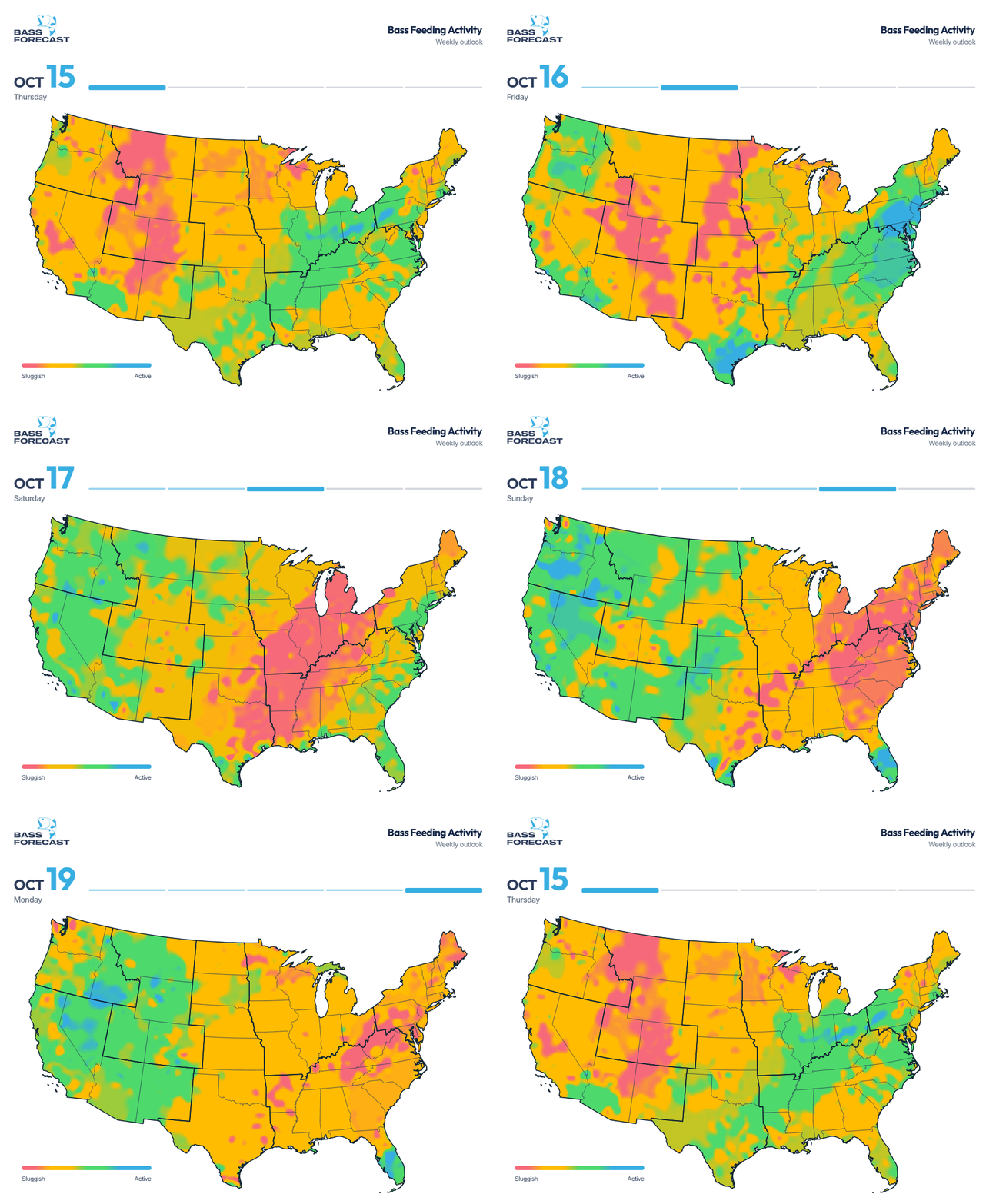
July bass fishing rewards anglers who know exactly what their local water is doing on any given day. Bass Forecast tracks water temperature, conditions, and solunar timing across regions so you know whether tomorrow morning is a frog day, a deep structure day, or a stay-home day before you load the truck.
Download Bass Forecast or use our Web app to plan smarter July trips.

-1739275914.jpg)
.jpg)
.jpg)
.png)
.png)