
Urchin Baits for Bass Fishing: The Breakout Trend of 2026 Explained
Share this article with every angler you know!
Urchin Baits for Bass Fishing: Why They Are Winning Tournaments and How to Fish Them
On May 17, 2026, Chris Johnston won the Bassmaster Elite at Santee Cooper with 113 pounds, 12 ounces. He caught most of his fish skipping a Hideup Coike Fullcast under main-lake docks in less than ten feet of water.
Two weeks later, Alex Davis took home a hundred thousand dollars at the NPFL event on Lay Lake throwing a Coike-style urchin bait.
On June 14, 2026, Jason Christie won his tenth Bassmaster Elite title at the Pasquotank River event using a weighted urchin bait rigged in a way that no article had documented before. Christie's rig used a frog-style double hook, a drop-shot weight, and a split ring, a combination that kept the hooks upright, kept the bait pinned to the bottom, and made the whole presentation weedless around dock posts and wood cover. On Championship Sunday, six of the top ten anglers had urchin-style baits on their front decks.
Three nationally televised professional tournaments in roughly four weeks were won using urchin-style baits. That is a remarkable adoption curve for an entirely new lure category. Bassmaster called urchin and fuzzy baits the "breakout trend of 2026." Tackle Warehouse created a dedicated ICAST category for them. The urchin bait has appeared in Bassmaster's Top Lures gallery for seven consecutive Elite events.
Every serious angler is asking the same three questions. What are urchin baits? Do they actually work? Should you buy one?
Here are honest answers to all three.
Sign up to be notified of new bass fishing articles!
Get the Bass Fishing Playbook Every Week
What Is an Urchin Bait?
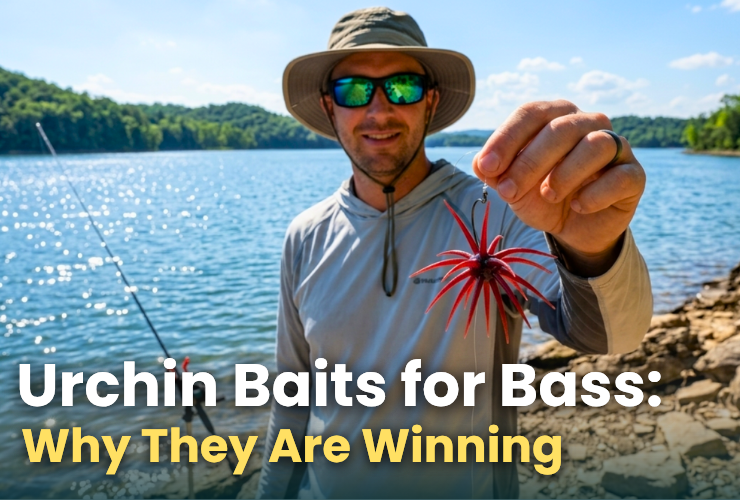
An urchin bait is a soft plastic bait with radial appendages that resemble the spines of a sea urchin. Compact profile, high leg count, pulsing action on the fall and during subtle rod movement. The category is distinct from creature baits, which typically have paired appendages and a defined body core, and from beaver baits, which have flat wide bodies with paired flappers.
Two subcategories exist within the urchin family. The smaller "dice" style baits run one to two inches and function as finesse presentations for pressured water and clear conditions. The larger Coike-style urchins run three to five inches and function as heavier profile baits for offshore structure, dock cover, and heavier weight applications. The tournament wins in 2026 have come predominantly on the Coike-style category.
The name is new even though similar shapes have existed for years in Japanese market baits and in obscure US products. What changed in 2026 is that the category earned mainstream identity. Products became widely available, professional anglers publicly identified them as a distinct category, and Tackle Warehouse gave them their own retail bucket. A shape that used to be a footnote is now its own aisle.
The Tournament Breakthrough That Started the Craze
The urchin bait trend did not build gradually over a full season. It broke through in a four-week window during May and June of 2026 that reshaped how competitive anglers think about the category.
Chris Johnston at Santee Cooper, May 17, 2026
Johnston won the Bassmaster Elite at Santee Cooper with 113 pounds, 12 ounces. His pattern centered on main-lake docks in less than ten feet of water, and his primary bait was the Hideup Coike Fullcast in Watermelon Seed and Scuppernong.
His rig was specific and worth understanding. A No. 1 Gamakatsu treble hook. A one-eighth-ounce tungsten nail sinker inserted into the body of the bait. He skipped the bait well underneath dock structure, counted it down to a specific depth, then triggered strikes with a sharp jerk followed by a double twitch.
Johnston credited lessons learned from LiveScope in previous events for the specific retrieve sequence. Watching fish react to different presentations on forward-facing sonar had taught him that a jerk-twitch-twitch cadence consistently drew strikes from fish that would ignore a straight retrieve. Forward-facing sonar was banned during the Santee event, but the lessons Johnston had internalized from previous exposure to it were carrying over.
Speaking about the urchin trend before the win, Johnston said, "There's hype for it, but there's a reason for it. I think it's justified."
His prediction on longevity was equally direct. "I think it's going to be good for about two years."
And his read on color selection is worth quoting for every angler about to overthink their tackle box: "I don't think the color is as important as the action on this bait."
That last quote challenges the color obsession that dominates most bait selection conversations and points at what actually matters with the urchin category. The action is doing the work. The color is secondary.
Johnston also had one Coike Fullcast left in his boat by the final day and reportedly told a Bassmaster photographer he would swim for it if it got snagged. The next day, he actually fell into the water retrieving it.
Alex Davis at Lay Lake
Davis won the NPFL event at Lay Lake shortly after Santee Cooper for a hundred thousand dollars, prominently featuring a Coike-style bait in his winning pattern. His post-tournament commentary added an interesting angle to the broader conversation.
When asked whether urchin baits might eventually get banned like the Alabama Rig was, Davis said, "Honestly, I still don't understand why the Alabama Rig was banned."
That answer says a lot about how the category is being discussed inside the tournament world. Anglers are already talking about whether urchin baits represent innovation or a competitive advantage that regulators might target.
Jason Christie at Pasquotank River, June 14, 2026
Christie's Pasquotank win was his tenth Bassmaster Elite title and put an exclamation point on the four-week urchin bait breakthrough. His pattern centered on creek-mouth docks holding post-spawn fish. Several other Championship Sunday competitors, including Fisher Anaya, were targeting spawning fish in five to seven feet of water. Christie was fishing slightly different water for slightly different fish, and his rig was unlike anything documented before.
He used a frog-style double hook attached to a drop-shot weight by a split ring.
The rig accomplished three things. It kept the hooks pointed upright and away from the cover. It kept the bait pinned to the bottom rather than swimming freely. And it made the entire presentation weedless around dock posts and wood cover where standard rigs would foul.
Bassmaster photographers specifically noted this unusual rig because they had not seen it before. Christie was reportedly the only angler in the field using the split-ring drop-shot-weight setup. On Championship Sunday, six of the top ten anglers had urchin-style baits on their front decks, but Christie's rigging was the differentiator that produced his win.
Brandon Palaniuk finished as runner-up and was also throwing urchin baits. His rig used a Hideup Coike Fullcast on a No. 1 BKK Spear 21 treble with a three-thirty-second-ounce tungsten nail weight. His biggest fish of the event actually came on a homemade urchin bait he had cast because he had run out of factory Coikes.
That detail matters. When a Championship Sunday competitor is catching his biggest fish on a homemade urchin, the takeaway is that profile and action are doing more work than any specific brand.
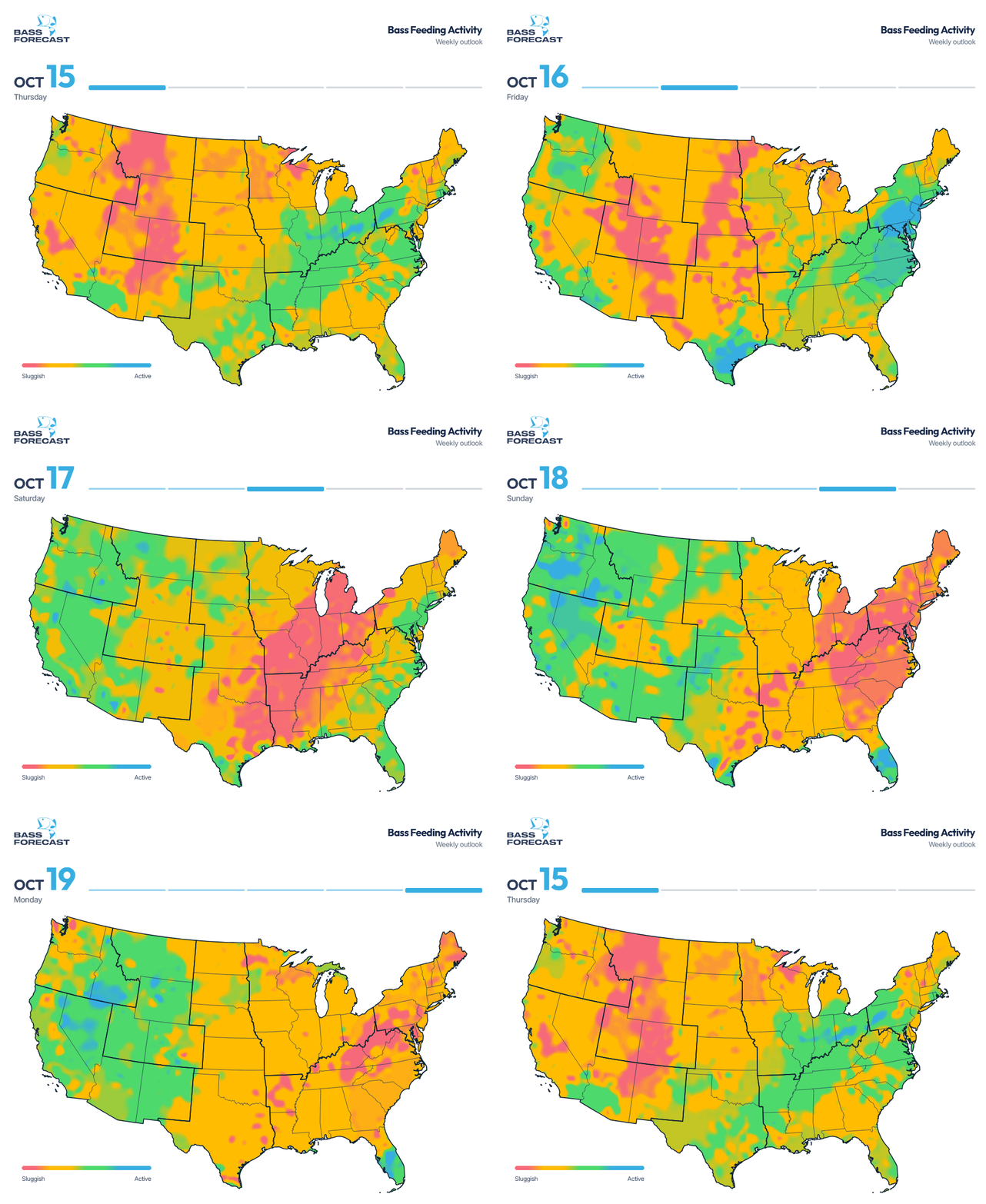
Check your local Bass Forecast ratings and intel report for your specific 10-day outlook, bite time windows, and bait recommendations tailored to your location.
Why Urchin Baits Are Producing Right Now
The tactical breakthrough is real. Understanding why urchin baits produce helps anglers know when to reach for one and when to skip the category entirely. Frame these as observed patterns rather than proven biology.
The compact profile advantage on pressured water. Urchin baits present a smaller silhouette than most creature baits and beaver baits at the same volume. On heavily fished water where bass have refused every standard presentation, a smaller profile with novel action reads as unfamiliar prey rather than another version of a bait the fish have already rejected.
The pulsing action on subtle movement. The radial appendages create movement on the fall and during any rod tip motion. Unlike creature baits with paired appendages that need aggressive movement to activate, urchin appendages pulse on their own. The bait produces action even when you are barely moving it. That translates to more strike opportunities per cast.
The slow fall rate as a strike zone extender. The high surface area from the radial appendages slows the fall rate significantly compared to a Texas-rigged worm or creature bait at the same weight. The bait stays in the strike zone longer, which matters when fish are inactive and need extended visibility to commit.
Novel category on pressured water. Every tournament win has been on pressured competitive water where fish have seen thousands of baits per season. The urchin category is new enough that fish have not yet learned to refuse it. That advantage will erode over time as the baits saturate every lake, but for now the novelty itself is part of the tactical value.
The Top Urchin Baits Right Now
Multiple products across price tiers now compete in the urchin category. Here is an honest breakdown of what to buy based on your fishing situation.
Hideup Coike Fullcast. The Japanese-made original and the bait that started the category. This is what Johnston and Palaniuk were throwing at Santee Cooper. The action is what all other urchin baits are compared against. Premium price and limited availability due to demand. If you can find them in stock, they are the benchmark.
Hideup Coike 17mm. The smaller finesse version of the Coike, increasingly used by Elite anglers for pressured water and clear conditions. Different tool than the Fullcast for a different situation.
Berkley MaxScent Moeba. The mid-range option with scent infusion and wider distribution. Available at major retailers where the Hideup products may be sold out. Solid choice for anglers who want to try the category without paying premium import pricing.
Hag's Prickly Pear. US-made and hand-poured. Tournament-proven and has developed a serious following among Southern anglers. Good option for anglers who prefer domestic products with hand-poured quality control.
6th Sense Abstract. The budget-friendly entry point with a wide color range. Accessible option for anglers who want to try the category without committing significant money to a single product line.
Homemade urchin baits. Increasingly common as factory products sell out. When Palaniuk caught his biggest Pasquotank fish on a homemade urchin, he made a broader point that reinforces the "action over brand" thesis. If you have the skill to pour your own soft plastics, the category is accessible without any factory product.
More urchin-style products are being teased around ICAST 2026 and the category is expanding rapidly. If you buy today, expect additional options within the next six months.
How to Rig an Urchin Bait
Multiple rigging options produce fish. The right rig depends on your water type, cover situation, and target depth.
The Trokar Double Frog Hook and Drop-Shot Weight Rig (Christie's Pasquotank Setup)
This is the rig Christie used to win the Bassmaster Elite at Pasquotank. It is not standard, it is not on most tackle store shelves, and it is likely the most tactically interesting rigging detail to come out of the 2026 tournament season.
The setup uses a frog-style double hook, a drop-shot weight, and a split ring connecting them. The weight sits below the bait, the hooks point upward, and the whole presentation stays weedless around dock posts, laydowns, and submerged wood.
To assemble: attach a Trokar TK130 2/0 double frog hook to a small split ring. Attach a drop-shot weight to the same split ring or to a short dropper line below the split ring. Thread the urchin bait onto the hook so the radial appendages splay naturally. The result is a bait that fishes on the bottom with hooks pointing safely away from cover.
The Weighted Hook Rig (Johnston's Santee Setup)
Johnston fished a No. 1 Gamakatsu treble hook with a one-eighth-ounce tungsten nail sinker inserted into the body of the bait. This is a more familiar rig type, functionally similar to a wacky rig with an internal weight. The bait falls with the belly down and the appendages splaying, and the tungsten insert keeps the presentation compact enough to skip under dock structure.
Palaniuk fished a similar setup with a No. 1 BKK Spear 21 treble and a three-thirty-second-ounce tungsten nail. Slightly lighter weight for slightly different water.
The Standard Texas Rig
For most fishing situations, a straightforward Texas rig with a light tungsten weight (one-eighth to three-eighths ounce) and a 3/0 or 4/0 wide-gap hook works. Nothing exotic required. This is the rig for anglers who want to fish an urchin bait without changing their standard setup.
The Weightless Rig
For shallow pressured water where you want the slowest possible fall rate, rig the bait weightless on a wide-gap worm hook. Let the natural fall rate of the urchin bait itself do the work. Ideal for spooky fish in clear water.
The Drop Shot Rig
For suspended fish and clear water conditions, drop shot rigging keeps the bait in the strike zone indefinitely. Standard drop shot setup with the urchin bait nose-hooked or wacky-rigged on the tag hook.
When and Where to Fish Urchin Baits
Not every water type or condition favors the urchin category. Here is when to reach for one.
Offshore structure and brush piles. The Coike-style urchin excels on offshore rock, brush, and ledge structure during summer patterns. Weighted rigs let you reach the depth range where fish hold, and the pulsing appendages produce on subtle rod work.
Grass edges and outside weed lines. The compact profile skips well and works cleanly through vegetation edges. Weightless or lightly weighted presentations produce best in this application.
Pressured tournament and public water. This is where urchin baits earn their reputation. On water that sees consistent fishing pressure, the category novelty and the pulsing action produce strikes when standard baits get refused.
Dock cover and wood structure. Christie's Pasquotank pattern proved this application. The right rig setup makes urchin baits skip-able and weedless around dock structure where standard rigs foul.
When to skip the urchin bait entirely. When your standard presentations are producing well, when you are on fresh unpressured water, when reaction bites are happening on faster moving baits. The urchin category's advantage is category differentiation and slow presentation. If neither is required, use what you already trust.
Trend or Tactic? An Honest Read
Bass fishing has trends every year. Some become permanent additions to the tackle box. Others fade within a season. Where do urchin baits sit?
Signs urchin baits are here to stay. Three professional tournament wins in four weeks driven by tactical differences, not marketing. Championship Sunday adoption at Pasquotank with six of ten anglers throwing the category. Consistent appearances in Bassmaster's Top Lures gallery for seven straight Elite events. Multiple brands expanding into the category with distinct product variations. Tournament-driven trends grounded in real tactical advantage historically stick.
Signs they might be a two-season craze. Johnston himself said the category will be good "for about two years." That aligns with historical bait cycles where a novelty category produces exceptional results for a limited window before fish learn the presentation. Similar cycles played out with the underspin, the Ned rig in its earliest peak years, and the wacky rig. Each remained useful long after the peak, but the initial edge dulled as saturation increased.
How to decide if urchin baits belong in your tackle. If you fish pressured competitive water or public tournament water, add them now. The tactical advantage is real and current. If you fish home water without significant pressure, add them selectively when your standard presentations are getting refused. If you are early in your bass fishing journey, master fundamental presentations first and revisit the urchin category when you have the base skills to recognize when a category shift is warranted.
The honest answer is that urchin baits are both a trend and a tactic. The tactic is real and worth learning. The trend is real and will produce diminishing returns over time. Anglers who add them now capture the current advantage. Anglers who wait until next season will still catch fish on them but will not have the same edge.
Frequently Asked Questions
What is an urchin bait for bass fishing? An urchin bait is a soft plastic bait with radial appendages resembling a sea urchin. Compact profile, high leg count, pulsing action on the fall and during subtle rod movements. The category emerged as a distinct product type in late 2025 and became the breakout trend of 2026 after three professional tournament wins in a four-week span.
Why are urchin baits so popular right now? Three major tournament wins in a four-week window in 2026 drove the category into mainstream visibility. Chris Johnston won at Santee Cooper on May 17. Alex Davis won at Lay Lake in late May. Jason Christie won at Pasquotank River on June 14. Six of the top ten anglers on Championship Sunday at Pasquotank had urchin-style baits on their front decks. The tactical breakthrough combined with tournament visibility has created the fastest-growing bait category of 2026.
What is the best urchin bait? Depends on your fishing situation. The Hideup Coike Fullcast is the premium Japanese-made original that Johnston and Palaniuk used at Santee Cooper. The Berkley MaxScent Moeba adds scent infusion at a mid-range price with wide availability. Hag's Prickly Pear is a US-made hand-poured option with tournament credibility. The 6th Sense Abstract is a budget-friendly entry point with a wide color range. Brandon Palaniuk caught his biggest Pasquotank fish on a homemade urchin, which suggests profile and action matter more than any specific brand.
How do you rig an urchin bait? Multiple rigs work. Jason Christie's Pasquotank rig used a Trokar 2/0 double frog hook attached to a drop-shot weight by a split ring, keeping the hooks upright and the presentation weedless. Chris Johnston fished a No. 1 Gamakatsu treble with a one-eighth-ounce tungsten nail sinker inserted into the bait body. Standard Texas rigging with a light tungsten weight covers most situations. Weightless rigging works in shallow pressured water. Drop shot rigging is effective for suspended fish and clear water.
Where do urchin baits work best? Offshore structure and brush piles. Grass edges and outside weed lines. Pressured competitive water where bass have refused standard presentations. Dock cover and wood structure with the right weedless rigging. The compact profile and pulsing appendages produce best when bass have seen enough of the standard bait selection to require category differentiation.
Are urchin baits just a fad? Too early to say definitively, but the tournament results and Championship Sunday adoption point toward tactic rather than fad. Chris Johnston himself estimated the category will be good "for about two years" before fish learn the presentation. That aligns with historical bait cycles where a novelty category produces exceptional results for a limited window before saturation reduces the edge. Even after the peak, the category will likely remain useful in the tackle mix.
When should I not fish an urchin bait? Skip the urchin bait when your standard presentations are producing well, when you are on fresh unpressured water where reaction bites are happening, or when speed and coverage matter more than slow deliberate presentation. The urchin bait's advantage is category differentiation and slow presentation. When neither is required, use what you already trust.
What color urchin bait should I buy? Johnston fished the Hideup Coike Fullcast in Watermelon Seed and Scuppernong for his Santee Cooper win. Both are natural color patterns that match forage in stained water. His own comment on the topic is worth reading again: "I don't think the color is as important as the action on this bait." Start with natural colors like Watermelon Seed or Green Pumpkin. The action of the bait is doing the work.
Use Bass Forecast to know exactly the best baits to throw
Urchin bait patterns produce best under specific conditions: pressured water, stable weather windows, and periods when standard reaction bites have slowed. Bass Forecast tracks barometric trends, water temperature stability, and solunar timing so you can identify the days when a slow-presentation category bait like an urchin is the right tool before you leave the truck.
Download Bass Forecast or use the web app to plan smarter bass fishing trips.


.png)

.png)
.png)