
Building a Winter-Only Bass Tackle Box: The Essentials You Actually Need
Winter fishing is a completely different ball game compared to any other time of year.
Sure, it’s basically the same process of picking a spot, casting, and reeling it back in, but all the little details are different, and it’s the ultimate challenge for most anglers.
If you’re just getting started with winter bass fishing, the first thing you need to do is set up a tackle box. Unfortunately, your approach is going to be very different if you want to succeed. So, your normal trust box of gear probably isn’t going to be a good idea.
The team at Bass Forecast is going to walk you through the winter bass tackle box essentials you'll need.
Why Make a Winter-Only Tackle Box?
If you’re an experienced angler who has a well-rounded box for the prime fishing season, you might be wondering why you even need to do this. Won’t your normal box have the lures and terminal tackle you need?
You might. Especially if you have a bigger box that’s very well developed. However, there are several reasons to build a winter tackle box, anyway.
First, if you don’t have a lot of tackle, you’re less likely to have winter-friendly staples in your box. Going through this checklist to build a box is a good way to see what you have and what you need.
Then, there’s the extra weight that comes from using an all-around box. In the winter, you’re already wearing more layers, you’re not able to move as well, and you’re traveling more slowly. Any extra weight compounds that problem.
By building a box that has only winter essentials in it, you minimize the weight you’re carrying.
There’s also the fact that a more streamlined box is easier to dig through. Your fingers are not going to work as well in the cold weather. You don’t want to dig through a giant fold-out box.
Depending on what gear you have, you might just have to transfer some of your existing gear to a new tackle box, but if you’re new, our list will guide you to buying all the essentials you need without wasting your budget on junk.
Everything we talk about is going to be found on Tackle Warehouse, or it’s so common in the sport that you can find it anywhere that sells tackle.
Getting Started: Picking a Tackle Box
You don’t need much for winter bass fishing. So, we like to stay away from the big tackle boxes with tons of compartments and trays. You don’t need that much space, and that’s a lot of weight to carry around in the winter.
Instead, single or double-layer compact boxes are our go-to options. Here are a few we love.
1: Buzbe Colony 8T
The Buzbe Colony 8T is super simple, lightweight, and foam-padded. It’s a single-layer tackle box that has one large slot that can easily hold several baits, and it has two smaller slots that are great for terminal tackle such as weights, hooks, and swivels.
At $26, it’s a bit more expensive than your standard single-layer Plano, but it’s foam-padded and built well.
Our favorite features include the Grid-Lock system that allows you to customize the internal layout, and the military-grade hinges that ensure a perfect seal and long-term performance.
Many similar boxes end up with broken latches because they’re not made as well.
2: Daiwa D-Box Deep
The Daiwa D-Box Deep is a simple plastic bin with several compartments, and it’s a single layer.
What sets it apart is that the compartments are twice as deep as pretty much every other single-layer box on the market. This keeps the box compact, but you can stash a lot more terminal tackle and copies of the same lure in each compartment.
At $20, it’s a steal. However, it’s not as portable as either of the other options on this list. The thickness can make it awkward to hold.
3: Flambeau
There are so many Flambeau single-layer boxes on Tackle Warehouse that we’re not going to name a specific one. Just look at the size and number of compartments on each one and pick what seems right to you.
All of them are basically the same in terms of features and build quality. They’re also cheap at just $11, but they’re still reliable.
If you’re just starting winter fishing and don’t want to invest in a high-end box for just a couple of months, or your budget is low, grab a Flambeau single-layer tackle box.
The Lures You Need for Winter Bass Fishing
You don’t need a whole lot of lures for winter bass fishing. You should really try to stick with just a couple, because you don’t want to constantly tie new lures on.
You’ll get your hands wet, and the bass are so lethargic that your usual 15-minute rule as you cycle through lures just isn’t necessary.
Instead, you need to focus on just a handful of bass-slaying lures that have proven to be the best cold water bassin producers.
1: Suspending Jerkbaits
A good suspending jerkbait is going to be your number one winter lure. If you could only carry 3 lures to the lake with you in the winter, we’d tell you to make one of them a suspending jerkbait. They’re that effective.
They’re particularly effective when you’re fishing in clear water. Luckily, winter tends to be when most of the North American waterways are at their clearest. The cold kills plantlife, algae can’t grow, and even some of the most stained lakes get surprisingly clear.
Jerkbaits work so well because they imitate a dying bait fish perfectly. Bass are extremely lethargic in the winter. They don’t want to chase your fast-paced crankbait 50 feet to get a meal. They want something easy.
Jerkbaits are also very simple for you to use. You let it sit, jerk the rod tip, reel in the slack, and let it sit for a short bit. You just keep repeating that pattern. It’s actually easier to learn how to use a jerkbait than it is to use a Texas rig, Carolina rig, and many other types of rigs you’ve probably used for years.
The exact jerkbait you need depends a lot on the type of bait fish and water conditions in your favorite fishing hole.
We personally like the Shimano World Minnow. It’s a little costly at $20 for one lure, but it’s worth every penny. It features Shimano’s Flash Boost and Scale Boost systems that make it shine, a "Jet Propulsion” system that gives it an extended casting range, and a remarkably good build quality.
You can also find plenty of good suspending jerks from brands like Rapala and Ima Gyodo on Tackle Warehouse. Take some time to look over your options and pick something that matches your budget.
Just keep in mind that more advanced and higher-quality lures are likely going to perform better. As the main lure in your winter setup, we recommend paying a premium for at least this lure because you will be fishing this in open water most of the time and thus a whole lot less likely to lose it to a snag during the course of a bass season. If you want to go cheaper with other options, that’s perfectly fine. But, with bites hard to come by during the winter, it is a wise investment to go with a more effective lure.
2: Football Jigs
Football jigs are going to be your go-to bottom fishing lures. You can chuck them in, let them sit, and drag them right over the rocks without getting snagged nearly as often as you would using more traditional jig heads that are more likely to get wedged between the rocks. These are meant to be fished slowly and methodically. They're perfect for winter bass fishing.
As for the brand you use, it doesn’t matter too much. You want a nice lure that’s not going to fall apart fast. You also want to make sure it has a good hook, because you don’t want the hook to straighten out with a bass on the line.
We recommend Strike King football jigs in green or blue colors with plenty of flash. We’ve caught countless bass on them, and none of them have let us down. If you have a preferred brand, it’ll probably work just fine.
When you’re using your football jig, let it sit for anywhere from 5 seconds to a full minute, and then sweep your rod very slowly before letting the lure sit again. The football design won’t catch on snag hazards as often, and this will look like a crawfish moving around on the bottom.
Since craws are easy meals and provide substantial energy for bass, they’re a delicacy in the winter.
3: Spoons
Spoons are old-school lures. They have caught more winter bass over the decades than any of the more modern lures we’ve talked about. They’re not our favorite, but you need to have at least one ready to go in your winter bass fishing tackle box.
The good thing is you can find spoons from all sorts of brands in practically every price range, and you can even make them yourself with minimal tools.
We like Rapala spoons, and we recommend getting various sizes. Chrome and brass are our favorites. You’re not trying to mimic a fish with a spoon. You just want to cause a lot of noise and flash in the water, and chrome and brass spoons do that very well. Plus, a “Flutter Spoon” fished like a jig flutters down the water column slowly, like a baitfish dying from the cold. Cast it out and let it all on a semi-slack line. Watch your line as it flutters down. Most strikes will happen in the fall. Sometimes you can feel it.
Other times, you will just see your line twitch. When either happens, set the hook immediately. Once the spoon sinks to the bottom, let it sit for 10 seconds, and then give it a sharp upward jerk of a few feet and let it flutter to the bottom again. Do this until you retrieve it all the way in. You will want to do this on clean lake bottoms so you don’t get snagged.
4: Lipless Cranks
Normal crankbaits aren’t essential in our opinion, but a lipless crank excels in the winter.
This is going to be your go-to lure for checking large sections of water quickly. You can adjust its depth on the fly, it triggers great reaction bites, and it’s a proven winter bait.
We love the Bill Lewis Rat’l’trap, but you’re free to check out other lipless cranks. Build quality, hook quality, and special features are the main differences you can expect. And, the go-to pattern for most late winter, very early pre-spawn anglers is the red craw pattern.
5: Crappie Tubes
This is not one that you’ll find on a lot of lists, but we use them every winter. Small crappie tube baits slid onto a standard ball jig can be popped through the water somewhat slowly with great results.
The reason we love these is that we can work the lure through much of the water column, and you can put a lot of different tubes into the single-layer tackle box we recommend.
You don’t need whole packs of every color, but grabbing one or two of a few winter-friendly colors and flash patterns will let you quickly cycle through your lures and find what the bass are looking for.
We usually don’t want to cycle through a bunch of lures in winter, but tubes allow you to tie on one jig head, and you can just swap the tube out in a second or two with very little effort.
Blue with white tails and silver flash has been one of our best color patterns, but it’s going to depend on the fishery you’re in.
Terminal Tackle for Your Winter Bass Fishing Kit
Finally, you’ll need a little terminal tackle. If you’re only using stuff from our checklist, you don’t need a lot at all.
First, get some craw trailers. These aren’t technically types of terminal tackle. They’re soft plastics meant to be used as accessories for jigs. However, they’re not used on their own. So, it fits the bill for this section.
A trailer is essentially a soft plastic craw without a tail. That allows it to sit flush with its backside against the jig head. This will enhance the crawfish profile of your football jig and help you get bites.
Then, you need to get some standard ball jigs. These are the old-school lead balls with hooks embedded in them. You’ll use them for the crappie tubes.
Other than that, it’s nice to have some flip clips. You can’t work with your hands as well, and clips will help you swap lures a lot easier in the cold. Nothing on this list really behaves poorly when clipped to the line. So, it’ll work just fine.
Since we didn’t list a bunch of soft plastics and various rig setups, you don’t need much terminal tackle.
Build Your Winter Tackle Box and Get Out There
If you get everything on this list, you’ll have all the winter bass tackle box essentials that are sure to catch you some bass while everyone else has hung their rods up for the year. Get out there and see why the pros fish all year round.
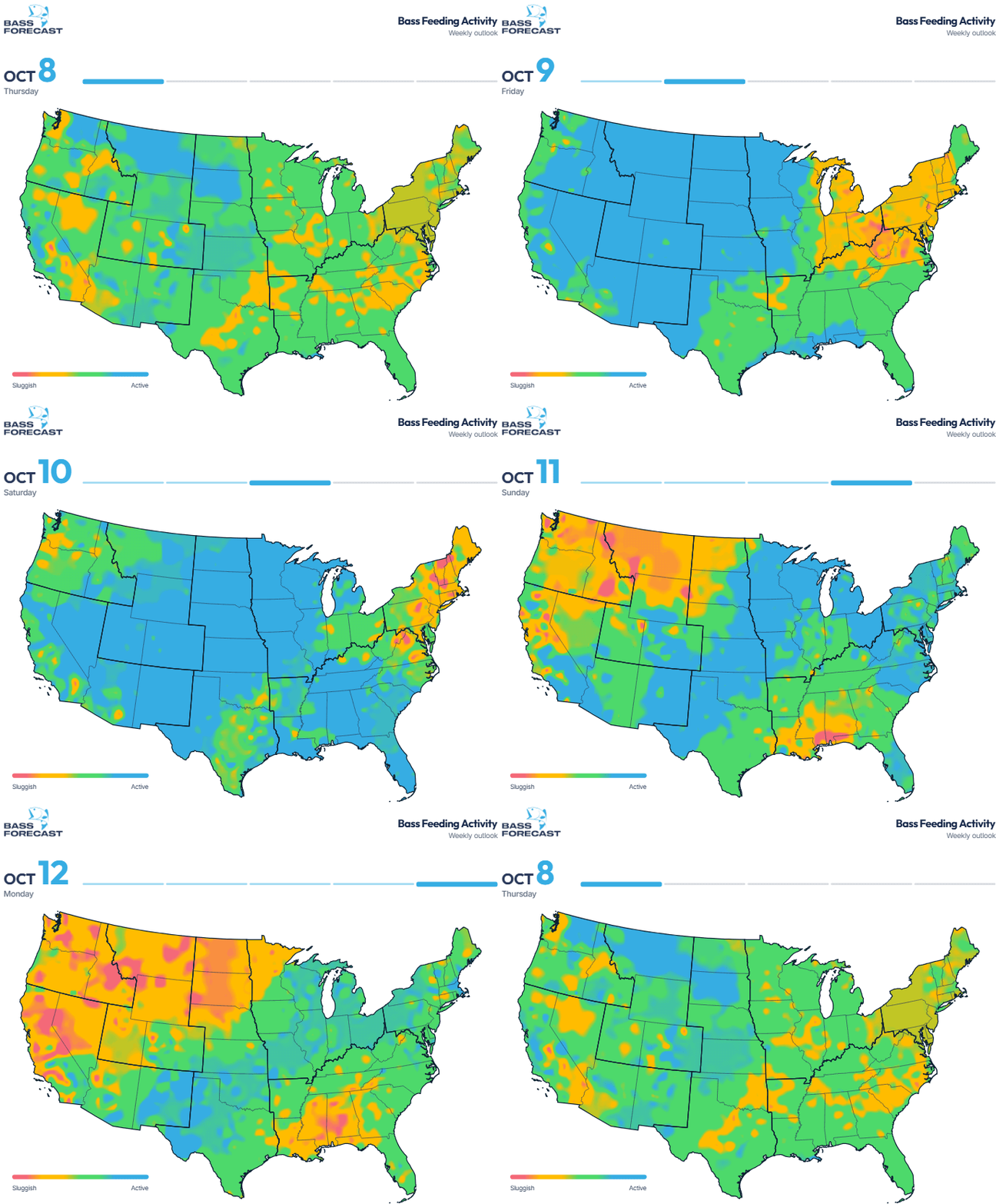
To find the perfect spots and times to try them out, download the Bass Forecast app!


-1739275914.jpg)
.jpg)
.jpg)
.png)
.png)